Ashley has been a travel advisor for five years, and she still has a full-time day job. This year she and her husband, who is also her business partner, passed $2 million in travel sales, more than double the almost $900,000 they sold in 2025, while raising two young boys. I sat down with her on our podcast to find out how. Here’s what she told me, with what I’d add from working with travel advisors on their marketing every day.
Who Ashley is
Ashley started booking travel five years ago. Disney was what she knew: her kids were young and so were her friends’ kids. Within about a year the business was growing, so she brought in her husband as her partner. Both kept their day jobs, and Ashley’s is in compliance, which turns out to matter. As the business grew, they found a large pocket of luxury clients who love taking their kids or grandkids to Disney but also want the Europe river cruise or the Japan trip they’ve dreamed about for years.
I’ve worked with Ashley for a couple of years, since she was at roughly $600,000 a year in sales. Watching her pass $2 million this year, while working a day job, is why I wanted her on the show.
Can you be a part-time travel agent and still grow?
Yes, but the hours have to be protected. Ashley is up around 6 a.m. with her boys, works her day job, then focuses on being mom until bedtime. After that it’s often back to the travel business, sometimes until midnight. She works from home, which keeps it flexible.
What makes it work is prioritizing. Everything goes on a to-do list with a date, and she decides each day what has to happen now. She has also reset expectations with clients: where she used to turn quotes around in 24 to 48 hours, some now take a little longer. Her rule on interruptions is practical. A casual question can wait until after dinner. A family planning a once-in-a-lifetime trip gets an answer when they call.
Running the business with her husband helps too. When one of them is out of capacity, because of the kids or a day job, the other tags in. They’ve since been able to move him to part-time at his day job.
The systems behind $2 million
Ashley’s background in compliance made her detail-oriented before she ever booked a trip, and she built the business the same way.
- One CRM, from the start. Early on she picked a CRM and committed to it. Entering every client felt tedious at first. Now, if someone isn’t in the CRM, they aren’t a client.
- Automated tasks and emails. She enters trip dates once, and automated emails and task reminders make sure every client is looked after. Other automations remind her to check on things.
- Start-to-finish processes. Bookkeeping and other admin follow a fixed process, done from start to finish without stopping in the middle, so nothing gets forgotten.
- A zero inbox. Her inbox is her to-do list. Anything still in it is still relevant. Everything else goes into folders, one per client. If a reply takes less than a minute, she does it right away.
One habit from her early days is worth copying. As a new agent she offered to assist bigger agents nearby. Some were booking millions a year from messy inboxes and sticky notes. She kept what worked, dropped what didn’t, and shared her own processes back. Her takeaway: everyone runs differently, so take what works for you.
Responsiveness beats the lowest price
“Being responsive in this business is critical. It’s not necessarily having the lowest price. It’s being responsive and being human.”
Ashley’s emails get a reply from her, not an auto-responder, and she prides herself on answering new clients quickly. She still gives clients her personal phone number. With so many travelers worried about talking to a robot, that human contact is a selling point.
I tell advisors the same thing. When you have a plumbing emergency, you hire whoever answers first. Travelers who find you on their own are actively looking for a solution. They might wait a little, but they won’t wait forever.
Treat every inquiry like a client for life
Her biggest open challenge is the same one most advisors have: reaching people who don’t know her yet, in a crowded market. Her answer is to treat every inquiry as if it’s a client who will book with her for life and refer their friends, whatever the source.
About half of new inquiries never reply. She lets herself feel bad for a second, then moves on, because every quote teaches her something. A Japan request she had never planned before became expertise; then three more Japan inquiries arrived from completely different places, and now she knows exactly what she’s doing.
Compete only against yourself
Ashley doesn’t measure herself against other agents. There will always be someone who sells more, and some agents she looked up to early on are away from home 40 weeks a year, which doesn’t fit a family with two young kids. Instead she compares each month with the same month last year, because travel is cyclical, and she sets a goal for every month. Already, she has close to $400,000 booked for 2027.
When she charges planning fees
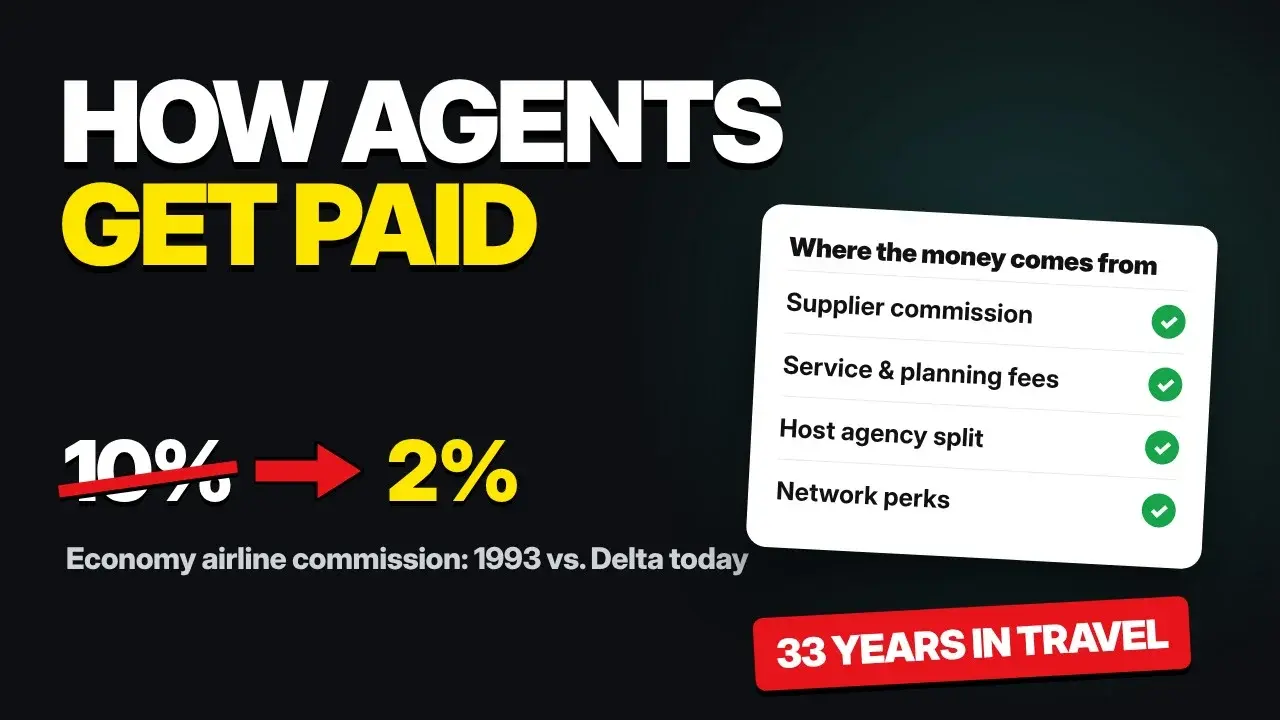
Ashley charges planning fees, but not on everything. For more on how fees and commissions fit together, see how travel agents make money.
- Many river cruises: usually no fee, because the commission is strong.
- New clients she has no connection to, for example from Google: often a fee, because there’s more risk they won’t book.
- Flights: always a fee. Clients are happy to hand them off, and she handles any issues.
- Disney: usually no fee, even though it’s a lot of work, because she knows it inside out and loves it.
How to move Disney clients into bigger trips
Many advisors start with Disney and Universal, then find the work is heavy and the commission sits around 10%. Ashley’s advice is not to drop those clients but to grow with them. A family’s Disney budget can often go toward a cruise or an all-inclusive, and those usually pay higher commission.
- 1Start on the first call. While planning dining and rides, she mentions her own family’s travel naturally, like the Disney cruise her boys loved. It’s genuine, not a script, and it shows she books more than Disney.
- 2Follow up about 60 days after the trip. An automated message asks: where to next? They may not have money right after paying for Disney, but they’ve been paying for it for six months, so it’s the right time to plan the next one.
- 3Ask for referrals and reviews. She tells happy clients the best thing they can do is pass her name on, and an automated email asks for reviews.
- 4Stay personal. Every client gets a holiday card with a handwritten note, a family photo and a QR code to her website.
Selling yourself as an introvert
Ashley is an introvert. She would hide under the table rather than speak to a crowd, but one-on-one calls feel natural. Her approach is to listen. When a client mentions they’ve always wanted to see Ireland, she asks when, with whom, and offers to book it. If being that available isn’t for you, she suggests finding a way to connect that suits you, whether that’s farmers markets or something else.
She also says no when she needs to. If a client yells or asks for something that doesn’t feel right, she lets them go and wishes them well. You work for yourself, so you choose who you work with.
What’s next for Ashley
Her next goal isn’t just more revenue; it’s a higher commission percentage, because that’s what really moves a business. She’s spent the last six months learning river cruise brands, including sailing them herself, with an AmaWaterways river cruise planned with her family for March 2027. Social media is still the part she enjoys least, but the business is growing without anything going viral. As I told her, you don’t need viral; you need to be in front of the right people, consistently. Our social media guide covers how.
Her advice for advisors stuck at a milestone
“You’re only working against yourself. Take what works for you, push everything else aside and just keep your head down.”
If you’re planning to leave your day job one day, read how Dana became a full-time travel agent next.
Frequently asked questions
Can you be a part-time travel agent?
Yes. Many advisors start part-time around a day job. Ashley still works full-time outside travel and passed $2 million in sales this year. It takes clear priorities, protected evening hours and systems that keep clients looked after when you’re at your other job.
How many hours does a part-time travel agent work?
It varies with your goals. Ashley works on travel mostly before and after her day job, often in the evening after her kids are in bed and sometimes until midnight. Automations and a CRM reduce the hours that follow-up and admin take.
How do part-time travel agents get clients?
Referrals and repeat clients are the foundation: ask happy clients to pass your name on, follow up after every trip, and stay personal. Answering new inquiries quickly and treating every one as a long-term client turns more of them into bookings.
Do part-time travel agents charge planning fees?
Many do. Ashley charges them for flights and for new clients she has no connection to, and usually not for river cruises, where commission is strong, or for Disney.

Will Lee
Co-founder & Marketing Strategist
Will builds the systems he writes about, then teaches them inside The Travel Agents Academy. Every play here was run on a real agency first.
More about Will